
Read the Parts of Madison County Property Tax Records
The tax trail in Madison County is split across offices and screens. Start with the parcel. The Tax Assessor's Land Roll Express is the right place to identify the parcel and its roll values. Use it for the roll values too. The bill and payment side lives with the Tax Collector's county-linked payment services. Delinquent sale and redemption papers later pass through the Tax Collector and the Chancery Clerk. Keep the tax year beside every figure. Comparing one roll's values against another year's bill only invites confusion.
| Tax-record item | Meaning | Official channel |
|---|---|---|
| True or market value | The assessor's appraisal starting point for the parcel | Tax Assessor land roll |
| Assessed value | The classified share of true value used in the tax calculation | Tax Assessor land roll |
| Land and improvements | Separate value components for the site and taxable structures | Tax Assessor record |
| Exemption or credit | Approved relief that changes taxable treatment | Tax Assessor and final bill |
| Bill and status | Tax year, amount billed, payment, delinquency, and penalties | Tax Collector lookup |
| Sale or redemption | Later action after unpaid tax reaches the annual sale process | Tax Collector and Chancery Clerk |
Mississippi treats these numbers as distinct. Class I owner-occupied residential property is generally assessed at 10 percent of true value. Most other real property falls under Class II at 15 percent. That class is subject to the state's classification rules. From there, the bill applies millage and any eligible relief. A deed tells a different story. Its consideration is a transaction figure, not the assessor's conclusion. It may reflect a transfer that never hit the open market.
Four Ways Into Madison County's 2026 Tax Roll
The assessor page identifies the current land roll as the 2026 roll approved August 17, 2026. It offers four entry modes. Each mode suits a different lookup task. The county publishes the modes themselves, and only those county-confirmed options appear here.
| Confirmed mode | Best use | Key to retain |
|---|---|---|
| Subdivision | Review parcels filed under one development name | Subdivision spelling and phase |
| Owner name | Find parcels carried under a person or entity | Name as displayed on the roll |
| Street name | Scan parcels along a road or block | Street spelling and parcel IDs |
| Parcel number | Open the closest available match to a known tract | 18-character parcel number or PPIN |
Record the physical address and the mailing address separately. The county's review form labels both. The assessor's mailing-address change procedure asks for the parcel number and the old and new mailing address. It also wants a daytime phone. That distinction keeps the tax-mail destination from being mistaken for the property's site.
The county's Land Roll Express landing page displays the available lookup choices.
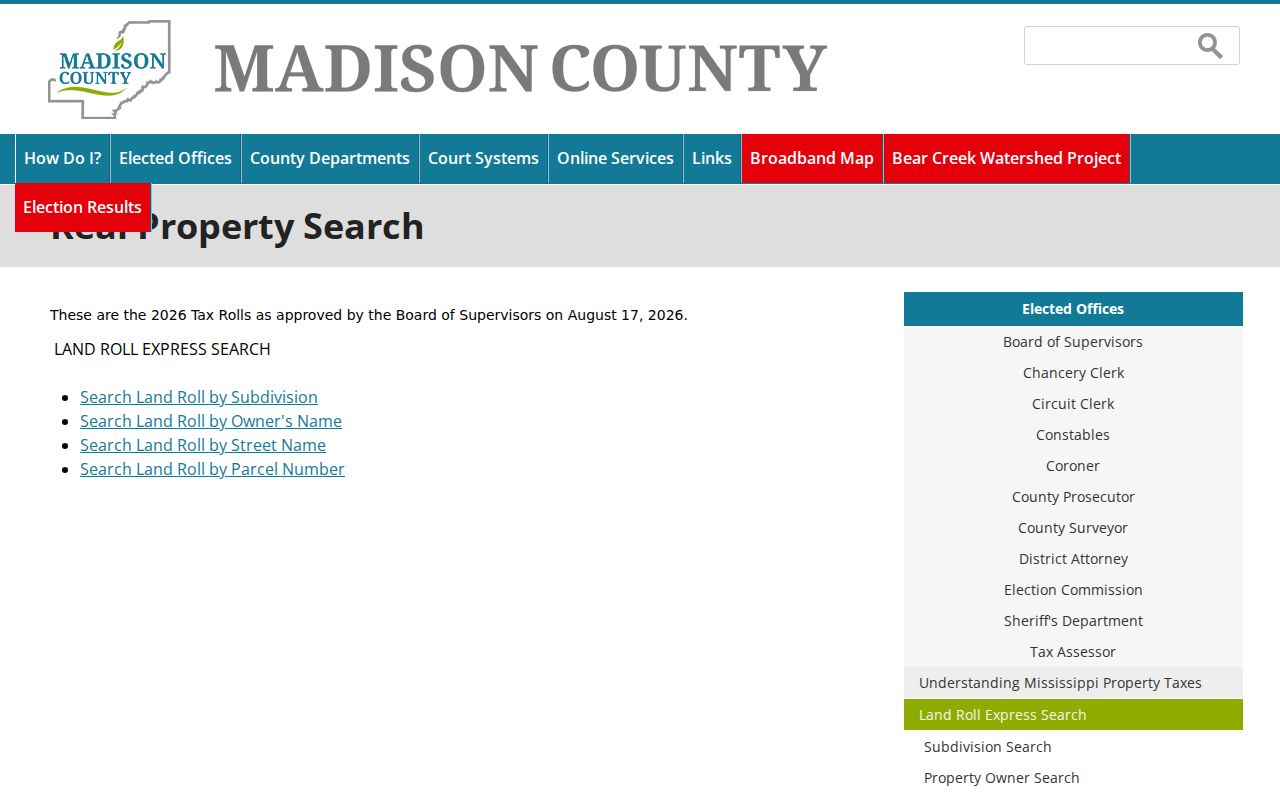
The county lists the four modes but does not publish a sample parcel card. The result fields themselves must be checked live.
Use the parcel search page when a tax bill already supplies the parcel number. The county does not publish every inner result label on the wrapper page. Assume nothing about a sale-history field until the search displays it.
How Madison County Turns True Value Into Assessment
True value comes first. The Mississippi Department of Revenue framework then applies the legal property class. A qualifying owner-occupied residence generally lands in Class I at 10 percent. Other real property generally falls into Class II at 15 percent. That step yields the assessed value, the base to which millage applies, and homestead relief may then adjust the final tax treatment in Madison County.
- True or market value
- The assessor's mass-appraisal estimate of the real property's full value.
- Assessed value
- The portion of true value produced by the applicable classification ratio.
- Millage
- The levy applied to assessed value for county, school, city, and other authorized purposes.
- Homestead exemption
- Relief available when an owner meets the state's residence and eligibility rules.
- Tax lien
- The public claim that can arise when property tax remains unpaid.
The Tax Assessor prepares rolls for Madison County, two school districts, and five cities. That explains why location, municipal status, and taxing district must stay separate even when two parcels share a mailing city.
Note: A city name in a postal address does not, by itself, prove the parcel lies inside that city's taxing boundary.
Follow a Madison County Tax Bill From Parcel to Payment
Fix the parcel on the correct tax year first. Then a bill lookup runs smoothly. The county links both PayStar for current payment activity and a separate View Property Taxes destination. Those vendor screens are dynamic, so treat the assessor's parcel identifier and the bill itself as the controlling references for any Madison County figure.
- Find the parcel through Land Roll Express by parcel number, street, subdivision, or owner.
- Copy the 18-character parcel number or PPIN, physical address, owner name, and tax year.
- Use the county-linked tax service and match the identifier before reading the bill or payment state.
- Compare the assessment and exemption treatment with the assessor record for the same year.
- If a balance is delinquent, check the Tax Collector's sale guidance and the Chancery Clerk's redemption channel.
The Tax Collector keeps a main office at 146 West Center Street in Canton. Branches sit at 171 Cobblestone Drive in Madison. Another sits at 168 Carter Street in Flora. All three are listed as open Monday through Friday, 8 a.m. to 5 p.m. The published phone numbers are 601-859-5226 in Canton, 601-856-4472 in Madison, and 601-879-9537 in Flora.
Official tax guidance also appears on the county's Tax Collector FAQ.
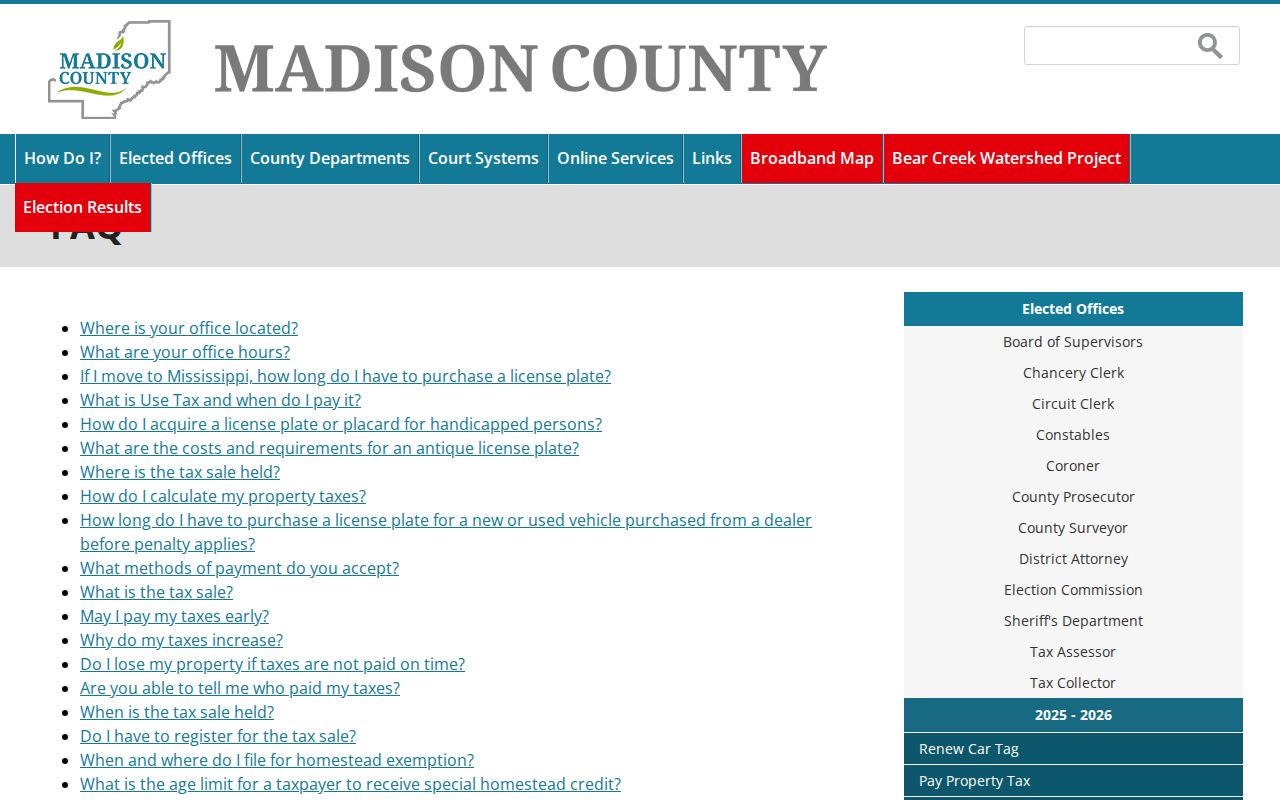
That FAQ is the source for the February due date, annual-sale timing, redemption period, and roll-lag rules described throughout this page.
The county also links the public current-tax payment interface for a bill search.
Use the county-linked payment channel for the bill itself. Match its results to the assessor's parcel and tax year before relying on any figure.
Madison County Delinquency, Sale, and Redemption Milestones
Madison County property taxes are due and payable February 1. A 0.5 percent monthly penalty accrues until the tax sale. The sale is traditionally held on the last Monday in August. It begins at 8 a.m. The Tax Collector directs bidders to GovEase for online sale registration. Keep these milestones distinct. Each one is a separate status, not a single blurred event.
| Stage | What the record means | Where to verify |
|---|---|---|
| Current bill | A tax-year charge that may still be payable without sale action | Tax Collector lookup |
| Delinquent balance | Unpaid tax with accumulating statutory penalty | Tax Collector |
| Tax sale | A sale event subject to the owner's redemption rights | GovEase and Tax Collector |
| Redemption | Owner may redeem within two years, with 1.5 percent monthly interest and Chancery fees | Chancery Clerk |
| Tax deed | A later conveyance that may issue only after the redemption period matures | Chancery land records |
Delinquent taxes must be paid before current taxes are accepted. A sale notice is not proof that the bidder owns the land. A redemption calculation is not a final tax deed, either.
Read the stage. Never treat a delinquent listing or tax-sale purchase as a final ownership record while redemption rights remain.
Why a New Deed May Miss Madison County's Next Roll
Madison County sets a firm cutoff for its annual land roll. A deed must be filed by December 31 of the prior year for the parcel to land on the next roll. Local property taxes are paid one year in arrears. That timing trips up buyers. A new owner who closes late in the year may open the next tax bill. The former owner of record may appear on it instead. That usually reflects the roll's cutoff, not a failed recording.
Check the recorded deed's filing date and grantee name to confirm the transfer took. Then compare the following year's land roll. The Madison County deed records guide covers the pre-2000 hard-copy boundary and the post-2000 terminal images. That way a tax lookup does not drift into a title search.
Note: Keep the deed filing date, roll year, and bill year as three separate fields when testing a recent transfer.
Madison County's Real-Property Review Form
The county's review worksheet gives the pre-appeal channel a concrete shape. It asks for the tax year and an 18-character parcel number or PPIN, along with the name, physical and mailing addresses, and contact details. It also covers authorization status, whether an appraiser was used, whether an appraisal was finished, its value, and the reason for the review. Appraisal material can be attached as support.
A signed Real Property Request for Review can be mailed to the Tax Assessor, Real Property Division, P.O. Box 292, Canton, MS 39046, faxed to 601-859-2899, or delivered in person. The office publishes no review fee and no processing time.
This is the route for asking the appraisal staff to inspect and discuss the roll before a Board of Supervisors appeal. Name the disputed field, the tax year, and the evidence. A narrow request works better than a broad records demand.
Contest a Madison County Property Tax Assessment on Time
Timing drives every Madison County assessment challenge. The assessor places the equalization roll for public review in July. Complete and sign the review worksheet by July 15. Staff then inspect the property and respond. If the answer still falls short, the owner files a formal written appeal with the Chancery Clerk by the first Monday in August.
Keep both deadlines. Submit the signed review request by July 15; a formal written appeal then reaches the Chancery Clerk by the first Monday in August.
The county's assessment FAQ is the source for that sequence.
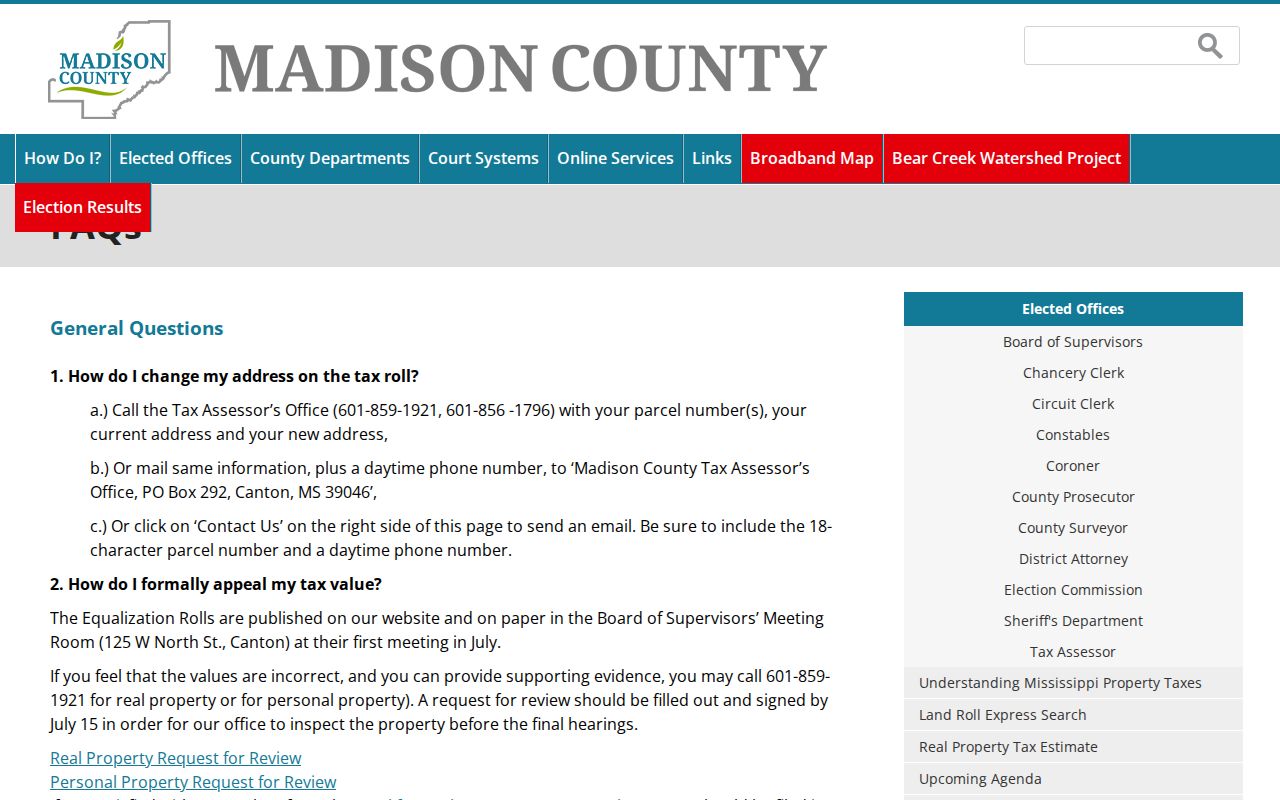
The notice separates staff review from the written appeal. Evidence matters at either stage. A recent appraisal, photographs, measurements, or comparable facts can all support the claim. So can proof that the parcel class or physical characteristics are wrong, though the county form should control what is actually submitted.
Request Missing Madison County Tax Material
Go to the responsible office for missing tax records. Guessing from a vendor screen wastes time. Current bills and payment questions belong with the Tax Collector, assessment data and review files with the Tax Assessor, and tax-sale redemption or an issued tax deed with the Chancery Clerk. The Mississippi Public Records Act, Miss. Code Ann. §§25-61-1 et seq., governs inspection requests. Exemptions and reasonable procedures still apply.
A focused request gives the parcel or PPIN, the physical address, and the owner as carried on the relevant roll. Add the tax year, desired fields, and preferred format. The office may charge actual search, review, duplication, and mailing cost in advance. Any denial must be written. It must also cite the exemption claimed.
Without an adopted procedure, production is due within one working day. Adopted procedures allow seven working days. A delay requires a written explanation, and fourteen working days is the outside date unless the requester agrees otherwise. Individual tax records protected by Miss. Code Ann. §27-3-77 stay exempt even though the parcel assessment roll is public.